
What is Pattern Grading?
So, what is Grading? Well, grading is a fundamental concept in pattern making and fashion design. It involves systematically adjusting the measurements of a finished pattern to create multiple sizes while preserving the style and proportions of the original design.


What is the Importance of Grading?
A finished pattern serves as the blueprint for a garment. Grading ensures that this garment is available in various sizes, from a UK 4 to a UK 22 and beyond, catering to diverse body shapes and measurements. Without Grading it would take a pattern maker a long and time consuming process to create multiple sizes of the same finished pattern. They would need to transform each different basic block size into a finished pattern by applying the same design elements whilst trying to maintain the proportions of the design elements for each size – A very laborious process!
The Grading Process
Pattern makers use a set of grading rules, which are like mathematical guidelines. These rules dictate how much to add or subtract from specific points on the finished pattern to create different sizes. They refer to a size chart or measurement table that provides measurement grades for each size. By following these rules, pattern makers modify the dimensions of the finished pattern, creating a new one to the intended size.

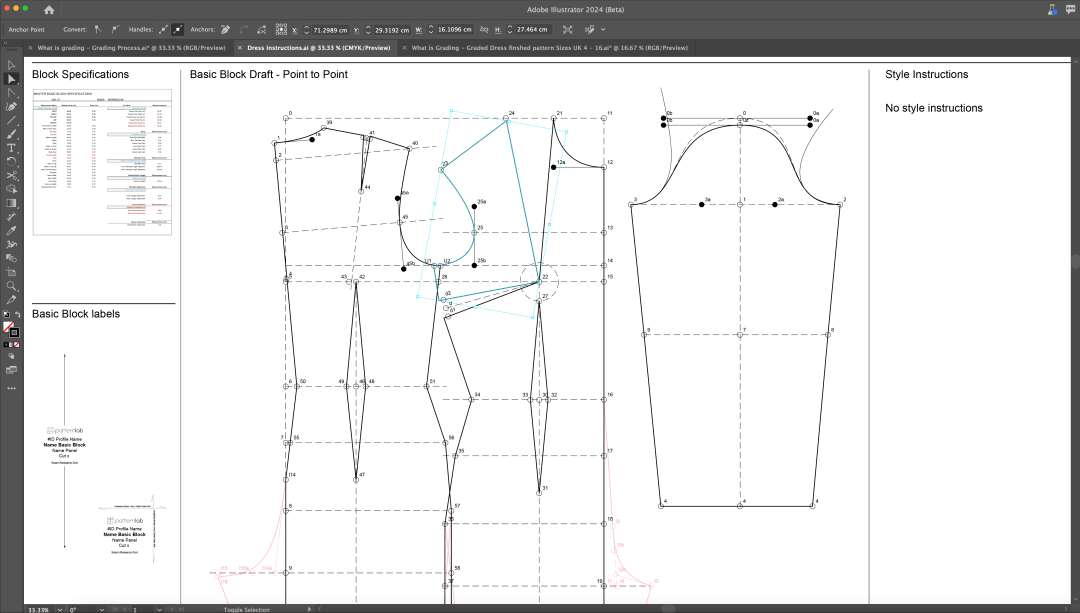
Understand the grading process in Adobe Illustrator.
Love pattern making in Adobe Illustrator ? Check out our tutorial that demonstrates the process a pattern maker might use to grade basic blocks, using Adobe Illustrator, as a pattern making platform. This tutorial also features information on how to scale finished patterns and basic blocks to fit on an A4 page for presentation.


Creating a Size Range
Grading results in a set of finished patterns for various sizes, ensuring that the same design is accessible to a wide range of people. A manufacturer can use these graded patterns to efficiently produce garments in different sizes. This speeds up the manufacturing process, saving time and resources.
Get a Library of Professional, Reliable, Standardised Basic Blocks
Grading Basic Blocks
While grading is commonly associated with finished patterns, it can also be used to create a range of sizes for basic blocks. Basic blocks are simple foundation patterns with a single purpose: to accurately fit the body. Although the process is like grading finished patterns, it’s more straightforward since basic blocks are far simpler in their design.
Our Approach at PatternLab.London
At PatternLab.London, we prefer manual drafting for each basic block size rather than grading. This approach creates better results across the size range, ensuring reliability and precise fits. As a result, grading is not utilized in any of our products, not even our sewing patterns (finished patterns).
Conclusion
In summary, grading is a vital component of pattern making, used for both basic blocks and finished patterns. It allows the creation of clothing in multiple sizes, accommodating diverse body measurements. Grading rules may vary depending on each finished pattern or garment but consistently help the versatility and inclusivity of clothing lines. This makes sure that fashion collections cater to a range of customers of different sizes.
I just need help with the grading. Do you guys have a more detailed video on how to grade the pattern after you have inputted your measurements in the system?
Hi Keisha.
Unfortunately, we are not graders, so we can’t expand on the process further. However, there re numerous companies that will grade your basic blocks and patterns. We’ve used MIG in the past: http://www.migpatterncutting.co.uk/